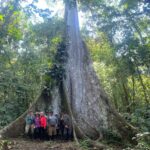
Walking in the Amazon: more than a rainforest experienceBy Carlos Aguilar - Amazon Specialist / 23/04/2026 The first step is always misleading.It feels like just a trail through trees. But after a few minutes… something changes.The air becomes heavier. The sounds begin to surround you. And without realizing it, you’re no longer observing the forest.You’re inside it. “Look closer” — the forest begins to reveal itself You don’t need experience.You don’t need to be a scientist.You just need to slow down.I stop in front of a tree with large, open leaves.Cecropia.“This tree wasn’t here long ago.”It’s a pioneer species—one of the first to grow after disturbance.Where there was light, exposed soil, or even cattle in the past…this tree appears first.It’s the forest’s way of starting over. The forest knows how to recover After logging or cattle ranching, the forest doesn’t completely disappear.It pauses.And then, slowly, it begins again.With species like:Cecropia, balsa trees, and guaba.They grow fast, improve the soil, and attract animals.They are the first step in rebuilding something much bigger.What looks like an empty space…is actually the beginning of a new forest. Look up — the forest has layers At some point, I tell you something simple:“Look up.”What seems like one forest is actually organized in layers—like a natural building. Emergent layerThe tallest trees, rising above everything else.They receive direct sunlight and face strong winds. CanopyA dense green roof where most life exists.Many animals spend their entire lives here. UnderstoryDarker and more humid.Plants grow slowly, adapted to low light.Forest floorCovered with leaves and organic matter.Nutrients recycle quickly, feeding the entire system. But the Amazon is not just vertical The forest is not only structured in layers.It is also a mosaic of different ecosystems.Each one feels different.Each one supports different life. Bamboo forestDense and almost impenetrable.Dominated by native bamboo.Some species live only in this environment. Palm swamp (Aguajal)Wet, soft ground, rich in fruit.A key feeding area for many animals.Terra firme forestNever flooded.Tall trees, complex structure.This is what most people imagine as “deep Amazon rainforest”.Flooded forestShaped by seasonal water cycles.A place where fish, trees, and wildlife interact in unique ways. Every forest has its specialists Not all species live everywhere.Each type of forest creates its own ecological niche.Some birds depend on bamboo forests.Some mammals rely on palm swamps.Some species can only survive in untouched primary forest.These are not random patterns.They are the result of thousands of years of adaptation. One connected systemEven though these forests are different, they are connected.Animals move between them.Seeds travel.Water links everything.The Amazon is not one forest.It is many forests working together. A difference you can fee As you walk deeper, the forest changes.In a young forest:* More light* Fewer layers* Less biodiversityIn a primary forest:* More structure* Greater balance* Life everywhereNo explanation is needed.You feel it. The forest’s sense of timeA forest can begin to recover in years.But to become what you see in a primary forest…it takes centuries.That is why protecting these forests matters.Because once they are gone,they do not come back the same. More than a destination Most people come to the Amazon to see nature.But when you understand it…you start to experience it differently.You don’t just walk.You observe.You connect.You understand. Final thoughtThe Amazon is not just a place.It is a living system.Layered. Connected. Always changing.And once you truly see it…You never walk through a forest the same way again. “This is not just a tour.It’s a way to understand the Amazon — the right way.”